|







"The tapes sound beautiful. Thank you for the great job and the pleasant,
courteous service.
It was a pleasure working with you."
|
|
Restoration

Hidden away in your attic, basement, closet
or garage may be old sound recordings, videos or photos of people, places
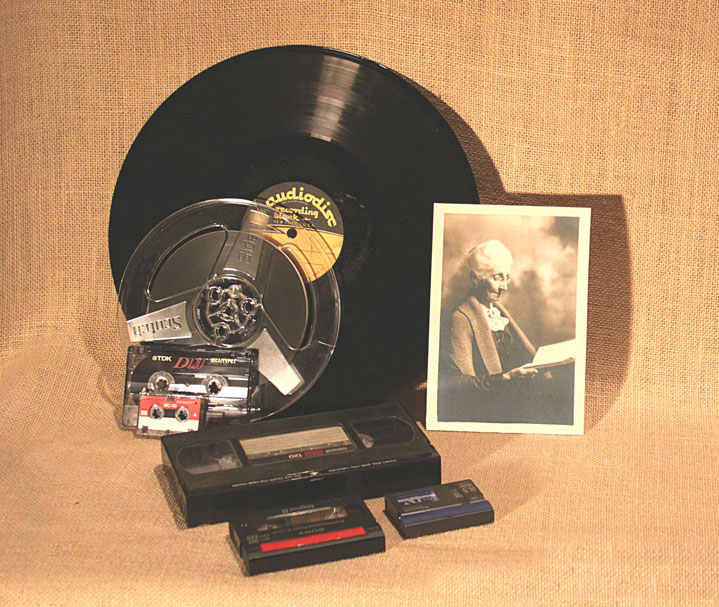 and events that have special meaning to you. Restoration is the process
of preserving your unique sounds and images on compact disc, DVD, flash drive or high-resolution print.
The process begins by creating a digital file.
and events that have special meaning to you. Restoration is the process
of preserving your unique sounds and images on compact disc, DVD, flash drive or high-resolution print.
The process begins by creating a digital file.
This is necessary
because no one has invented a machine that allows feeding your original materials into
it and having the finished product pop out an instant later. Also, transferring your original materials directly to disc isn't
practical either because a number of difficulties may arise along the way:
 |
In playing a disc recording, the stylus
(needle) can skip a record groove - or become stuck in one.
|
|
|
Open-reel tapes may contain splices
that fail on playback.
|
|
|
An old,
brittle tape may break and require the use of specialized tools to repair. |
|
|
An original tape may have been recorded at multiple speeds and have to be processed in sections. |
|
|
A videotape may have unwanted portions needing removal, or dull parts needing brightening.
|
|
|
A vintage photo or document may require
physical repair.
|
|
|
Special effects may be required to enhance picture quality.
|
With the use of digital technology, the most important advantage to you is the
level of control possible in restoring and preserving your original materials.
And the most important part of the preservation process isn't the technology but the
experience and skill of the user.
Audio
Digital technology, skillfully applied, allows enhancing poor-sounding recordings.
|
|
Background sounds can be reduced.
|
|
|
Voices may be brought further forward.
|
|
|
Unwanted music or dialogue can be deleted.
|
|
|
Annoying noises can be reduced.
|
|
|
Speed and pitch are adjustable.
|
|
|
Monaural recordings can be enhanced for a pleasant stereo effect.
|
Video
|
|
For a video too long for a single DVD, skilled use of digital technology allows determining the exact running time of the progam, and where it might be appropriately divided for transfer to two or more discs.
|
|
|
Unwanted sections can be deleted. |
|
|
Dull sections may be brightened. |
|
|
Titles can be added. |
|
|
Audio tracks can be added or deleted. |
Photo
|
|
Photos may be retouched to remove blemishes.
|
|
|
In some cases, missing sections can be restored. |
|
|
Colors, brightness and contrast can be adjusted. |
|
|
Images may be croped, enlarged or reduced. |
|
|
35mm slides can be scanned and converted to a movie format. |
All of these benefits are available to you only through the skilled, creative use of digital technology.
Delivery
Original materials are best delivered in person. For out of state clients, the U.S. Postal Service has proven quite dependable.
Send only by Certified U.S.Mail. It's safer. So far, we've successfully served clients in Arizona,
California, Delaware, Florida, Georgia, Illinois, Indiana, Kentucky, Maryland, Minnesota, New Jersey, New York,
North Carolina, Ohio, Oklahoma, Oregon, Tennessee, Texas, Vermont, Virginia, Washington, West Virginia and Hawaii.
Rates, Audio
Rates, Video
|
|
Video recordings up to two hours in length
|
|
$39.95* |
|
|
Included: two DVDs with labels & cases**
plus archival copy retained for ten years. |
|
|
|
|
*Additional length per minute |
|
$ .60 |
|
|
**Flash Drive: from |
|
$10.49
|
Rates, Photo
|
|
Create high-resolution digital file from your original
image |
|
$24.95 |
|
|
Align and crop - remove unnecessary peripheral material |
|
Included |
|
|
Basic retouching,one-quarter hour |
|
FREE |
|
|
Detailed retouching, per quarter-hour:
Reduce or eliminate cracks in original photo
Remove unwanted persons or objects
Reconstruct missing portions, etc.
Restore damaged or missing text
Enlarge original image
Change image proportions
|
|
$11.25 |
|
|
CDR (jpeg) with label & case |
|
$5.95 |
|
|
Flash Drive: from |
|
$10.49 |
|
|
High -resolution print |
|
$5.95 |
|
|
*Assemble series of photos as movie on DVD
Please ask for estimate |
|
|
|
Summary
Whether you have sound recordings, videos, photos or documents, skilled, creative use of digital technology
can preserve - and often improve - the quality and condition of your
original materials. The secret, of course,
is not the system but the operator .
For detailed adjustments, additional charges may apply.
For more involved projects, please call for a quote as charges tend to vary widely.
After watching so many seasons of CSI-type TV shows, too many truly believe that this work is quick, easy, simple and fast.
Not so! Processing a one-hour audio can take as long as three hours.
A six-hour video will occupy the better part of two days. Reconsructing a vintage document might take a week.
|
|

© 2021 King Street Recording
Company
|
